
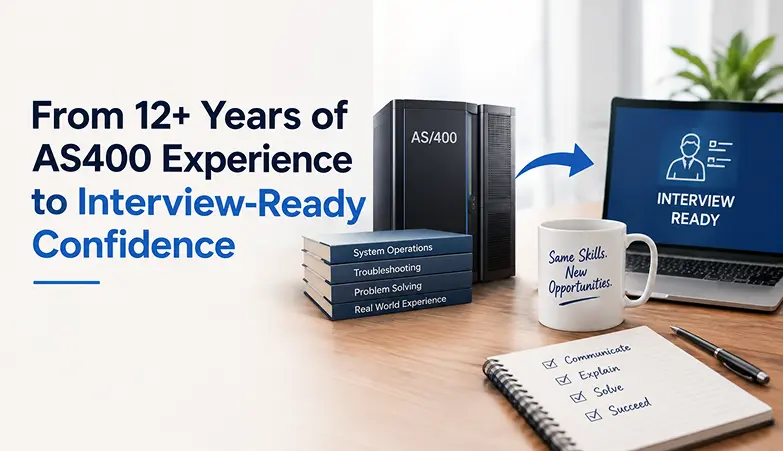
September 18th, 2026
“We had one candidate he has 12+ years of AS400 experience, but after spending the last two years in delivery management and team handling, he feel like he have lost some of my technical touch. In interviews, he can answer application-level questions, but explaining core coding concepts has become challenging.”
This is a situation many experienced AS400/IBM i professionals can relate to.
After years of working in support, delivery management, team leadership, client coordination, or application management, hands-on technical work can naturally reduce. When it is time to attend a technical interview again, professionals may suddenly face questions that require deeper coding knowledge, technical explanation, debugging skills, and scenario-based thinking.
But there is an important point to remember:
A gap in hands-on coding does not erase years of experience.
The goal is not to start your career again. The goal is to refresh your technical skills, rebuild your coding confidence, and reconnect your experience with today’s interview expectations.
Professionals with 10+ years of experience often move into:
These responsibilities build valuable professional and business skills. However, when hands-on development becomes less frequent, some technical concepts may not remain as sharp as they once were.
Then comes the next career opportunity.
The interview may move quickly from application-level discussions to technical questions involving:
RPG → CL → DB2 → SQL → Application Logic → Debugging → Coding → Scenario-Based Questions
This is where experienced professionals may feel:
“I know this concept, but I haven’t worked hands-on with it recently.”
That difference between knowing something and being able to explain and demonstrate it confidently can make technical interviews challenging.
Years of AS400 experience provide knowledge that cannot be developed overnight.
An experienced professional may already have exposure to:
This experience remains valuable.
The challenge is often connecting that experience with the technical depth expected in a current interview.
Instead of thinking: “I need to start learning AS400 from the beginning.”
A better approach can be: “I need to identify what I already know, refresh what I have forgotten, and strengthen the areas where I need more hands-on practice.”
Refresh important programming concepts and practice explaining how RPG programs work in real application scenarios.
Review CL commands, program execution, jobs, objects, libraries, and commonly used operational concepts.
Strengthen understanding of database structures, tables, files, relationships, and how applications interact with DB2.
Refresh SQL queries and understand how SQL is used for retrieving, updating, joining, and analyzing application data.
Practice identifying problems, tracing application flow, analyzing errors, and explaining troubleshooting approaches.
Review the underlying concepts that help explain how applications, jobs, objects, libraries, and databases work together.
Connect technical knowledge with real production situations such as job failures, data issues, program errors, performance problems, file-related issues, production incidents, and application changes.
Technical interviews are not always about whether you have encountered a technology before. They often require you to explain how something works and demonstrate your understanding through practical situations.
| Situation | Interview Response |
|---|---|
| Concept knowledge | “I know RPG.” |
| Technical understanding | “I can explain how this RPG program works.” |
| Practical understanding | “I can explain where this program is used in an application.” |
| Troubleshooting ability | “I can explain how I would investigate this production issue.” |
| Interview confidence | “I can explain the concept and support my answer with a practical example.” |
The objective of interview preparation should therefore go beyond simply revising definitions.
It should help you understand, apply, explain, and discuss technical concepts confidently.
Start by understanding what you remember and where you need a refresh. Ask yourself which AS400 technologies you have worked with recently, which concepts you have not used for several years, whether you can explain previous projects technically, whether you can write or understand basic RPG code, whether you can troubleshoot a typical application issue, and whether you can answer scenario-based interview questions.
Revisit the fundamentals before moving into advanced topics. Focus on the technologies most relevant to your target role.
Spend time practicing RPG/RPGLE programs, SQL queries, CL commands, database operations, and debugging scenarios.
Take concepts and connect them with situations you have actually experienced. Technical Concept → Project Experience → Production Scenario → Interview Explanation.
Prepare for technical, coding, scenario-based, production support, project-based, troubleshooting, and architecture-related questions.
Practice explaining What → Why → How → Where → Real Example. This can improve technical communication during interviews.
For example:
Imagine an AS400 professional with 12 years of experience who has spent the last two years primarily handling delivery management and team responsibilities.
The professional has strong knowledge of the business application and production environment but has not written RPG code regularly during that period.
During an interview, the interviewer asks a technical question about RPG program flow. The professional understands the concept but struggles to explain it clearly.
Instead of treating this as a complete skill gap, the professional can approach it as a technical refresh requirement.
A structured preparation plan could involve:
RPG fundamentals → Coding practice → DB2/SQL refresh → Debugging → Application scenarios → Mock interview practice
The professional can then connect previous project experience with refreshed technical knowledge.
The objective is not to pretend that the technical gap never existed. The objective is to systematically close the gap.
Technical refresh is only one part of the equation.
Your existing experience can provide significant context when preparing for interviews.
The opportunity is to combine this experience with renewed technical confidence.
Experience + Technical Refresh + Hands-On Practice + Interview Preparation can help create a stronger foundation for your next career conversation.
You don’t necessarily need to start over because you have spent time away from hands-on coding.
Your experience, production exposure, business understanding, and leadership skills still matter.
What may be needed is a focused technical refresh that helps you reconnect your existing experience with current interview expectations.
Refresh your skills. Practice your coding. Reconnect with the technology. Prepare for real interview scenarios. Build your confidence.
Yes. The transition depends on the individual’s previous experience, current technical skills, target role, and the level of technical refresh required. A structured preparation plan can help identify and strengthen technical gaps.
The areas depend on the target position, but commonly relevant areas may include RPG/RPGLE, CL, DB2, SQL, debugging, AS400/IBM i concepts, application architecture, and production support scenarios.
Technical interviews can include practical, coding, troubleshooting, and scenario-based questions. Hands-on practice can therefore be useful for strengthening your ability to apply and explain concepts.
Not necessarily. Your previous experience provides a foundation. The right approach may be to assess your current knowledge, identify gaps, refresh important concepts, and practice the areas that need strengthening.
Practice is important. Focus on explaining technical concepts in your own words, solving practical problems, discussing previous project experiences, and practicing scenario-based interview questions.
A career journey does not always move in a straight line.
You may spend years coding, then move into support. You may move from development into delivery management. You may lead teams, work with clients, manage production environments, and coordinate projects.
When you decide to return to a more technical role, it is natural to discover that some technical skills need refreshing.
That does not mean your experience has disappeared.
Your experience is still there. Your knowledge is still there. Your production exposure is still there.
The next step may simply be to reconnect those strengths with refreshed technical skills and stronger interview preparation.
Don’t start from zero. Start from your experience — and build from there.
At Evolvv, we help individuals and organizations build future-ready GenAI capabilities, starting with Prompt Engineering.
We focus on delivering practical, real-world training that transforms how teams think, communicate, and grow.
Want your team to experience the same transformation?
Let’s connect:
+91 6363 644 347 evolvv@techvito.in
 Your Response was submitted.
our team will contact you shortly.